
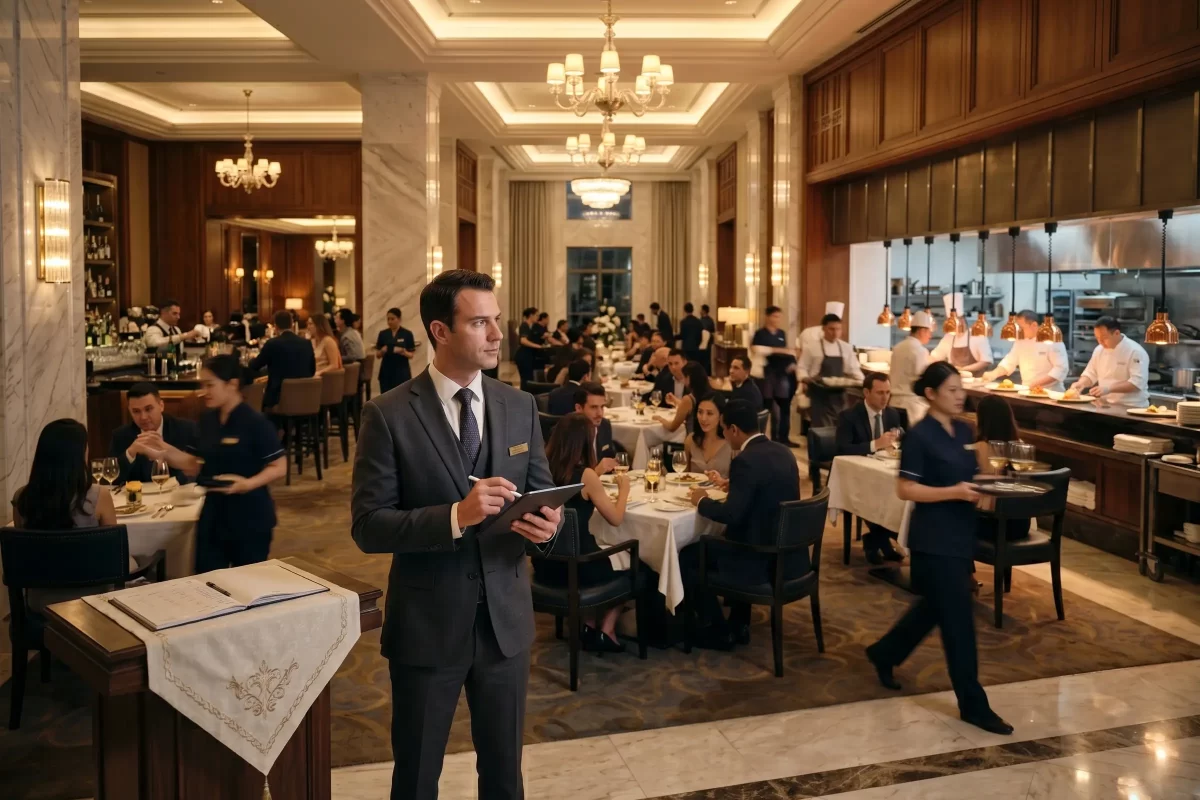
Any hospitality operation can look well-managed on a quiet Tuesday afternoon. The true measure of your systems, management, and hospitality SOPs is entirely dependent on how they hold up under the crushing weight of a Saturday night dinner rush at 7:30 PM. When the volume doubles, the operational friction multiplies exponentially. If your restaurant or hotel F&B operations are relying on the sheer willpower of your staff rather than engineered systems to get through peak hours, you are losing substantial revenue.
The core problem during high-pressure volume is a breakdown in the “flow of service.” Flow is the sequential, uninterrupted movement of guests, information, and product through your physical space. When flow is disrupted, bottlenecks form. In both freestanding restaurants and high-volume hotel dining rooms, a bottleneck in one department immediately paralyzes the next. If the host stand seats too quickly (the brain), the service bar backs up (the nervous system). When the bar backs up, drink times exceed 10 minutes, frustrating the guests before they even order food. The servers, anxious about the drinks, delay firing their food tickets. Then, they fire all their tables at once, slamming the kitchen expo line. The kitchen crashes, ticket times push past 40 minutes, and table turns grind to a halt.
This cascading failure happens because operators treat Saturday night as an unpredictable natural disaster to be survived, rather than a predictable data-gathering event to be engineered. Without a rigorous restaurant operational audit conducted specifically during peak stress, your management team is merely firefighting symptoms instead of curing the underlying disease. You cannot optimize what you do not measure under pressure.
Actionable Solutions (The “How-To”)
To fix peak-hour chaos, you must act as your own internal hospitality operations consultant and execute the “Saturday Night Stress Test.” This requires a manager or auditor to step completely off the floor—no expediting food, no touching tables, no seating guests. Armed with a stopwatch and a floor plan, you will track the exact flow of service through four critical zones to achieve total restaurant flow optimization.
Phase 1: Auditing the Host Stand & Front Door
The host stand dictates the entire rhythm of the evening. If you lose control of the door, you lose the shift.
- The Hotel F&B Audit Example: In a hotel restaurant, you face the unique challenge of walk-in hotel guests who feel entitled to a table immediately, bypassing your reservation system. The stress test must track how the host handles the “VIP bypass.” Are they blindly double-seating an already overwhelmed section just to appease a diamond-tier guest, thereby crashing the server and the kitchen?
- The Restaurant Audit Example: Track the seating velocity. A freestanding restaurant host should seat a maximum of 4 to 5 tables per 15-minute increment per kitchen line.
- The Solution: Implement “Staggered Seating Controls.” During your audit, physically clock the time between seatings. If the host seats three tables in three minutes, intervene. Mandate a strict 3-minute pause between seating parties. This forces a natural stagger in drink orders and food tickets, protecting the bar and kitchen from sudden spikes.
Phase 2: Auditing the Service Bar Bottleneck
The service bar is notoriously the first point of failure on a Saturday night. If drinks take more than 5 minutes to hit the table, the guest’s perception of the entire meal is negatively anchored.
- The Hotel F&B Audit Example: Hotel bars often serve dual purposes—handling the lobby lounge guests and the main dining room service bar simultaneously. During the stress test, time the ticket delays. Is the bartender prioritizing the guest sitting directly in front of them over the service ticket that prints for a dining room table?
- The Restaurant Audit Example: Stand at the service well with a stopwatch. Time exactly how long it takes from the moment the ticket prints to the moment the server garnishes and runs the drink.
- The Solution: Optimize the physical ergonomics of the service well. If your audit reveals the bartender is taking 6 steps to reach the glassware or the ice bin is positioned poorly, redesign the station. Furthermore, implement a “3-Minute Rule.” If a ticket hangs for 3 minutes, a floor manager must physically intervene to run the drinks or assist the build.
Phase 3: Auditing the Kitchen Expo Line
The expediter (Expo) is the air traffic controller of your kitchen. The stress test here focuses purely on ticket times and food flow.
- The Hotel F&B Audit Example: In a hotel, the main kitchen might be simultaneously pushing out 40 room service orders alongside a 200-cover dining room rush. The audit must track if in-room dining tickets are derailing the hot line’s rhythm for the restaurant.
- The Restaurant Audit Example: Watch the physical movement of the food. Are dishes dying in the window because the heat lamps are full? Are food runners confused about table numbers?
- The Solution: Establish strict time-standard KPIs. Appetizers must be in the window in 10-12 minutes; entrees in 18-22 minutes. During the audit, pull three random tickets and track them from POS entry to table drop. If the kitchen is missing these marks, your menu may be too complex for peak volume, requiring a menu matrix simplification (removing high-prep, low-margin items that stall the line).
Phase 4: Auditing the Table Turnover Rate
Table turnover rate is the ultimate metric of Saturday night profitability. You cannot sell a seat you cannot clear.
- The Hotel F&B Audit Example: Hotel breakfast buffets or high-volume brunches require rapid clearing. If bussers are taking 8 minutes to clear and reset a 4-top, you are artificially capping your revenue.
- The Restaurant Audit Example: Track the “Ghost Time”—the minutes a table sits empty and dirty after the guests have walked out the door.
- The Solution: Implement “Pre-bussing to the Wood.” A table should be completely cleared of everything except the glasses the guests are actively drinking from before they even ask for the check. Once they leave, resetting the table should take no more than 60 seconds.
Common Pitfalls to Avoid
When operators attempt to fix their peak-hour flow, they frequently make critical, revenue-draining mistakes:
- The “Working Manager” Fallacy: The most common mistake during a Saturday night rush is managers jumping in to cook on the line or take a section of tables. When a manager drops their head to expedite food, the rest of the restaurant is flying completely blind. Managers must direct traffic, unblock bottlenecks, and maintain situational awareness, not do the work of an hourly employee.
- Over-Seating to Appease the Lobby: Giving into the pressure of a crowded lobby or an angry hotel guest by seating them at a dirty table or forcing them into an overwhelmed server’s section. You are trading a problem in the lobby for a permanent disaster in the dining room. An angry guest waiting in the lobby is bad; an angry guest sitting at a table for 20 minutes without seeing a server is catastrophic.
- Ignoring the “Menu-Mix” Bottleneck: Trying to make the kitchen cook faster when the real problem is that 40% of the Saturday night orders are for a dish that takes 25 minutes to sauté. You cannot out-train a poorly engineered, high-friction menu.
Apply This Tomorrow (15-Minute Action Plan)
You do not need to wait for the weekend to start laying the groundwork for your restaurant stress test. Take 15 minutes during your next shift to implement these immediate steps:
- The Ticket Time Pull: Go to the POS system and pull the ticket time averages for your most recent Friday or Saturday night between 7:00 PM and 8:30 PM. Highlight any ticket that exceeded 25 minutes and identify which station caused the delay.
- The Host Stand Audit: Stand at the host desk for exactly 15 minutes during your next rush. Count how many tables are seated simultaneously. If you see more than three tables seated in a 5-minute window, immediately institute the 3-minute pause rule.
- The Pre-Bus Sweep: Walk your dining room floor right now. Count the number of tables that have empty plates sitting in front of guests who have finished eating. For every plate you find, deduct a point from your front-of-house efficiency score. Instruct your team that pre-bussing is a mandatory, non-negotiable standard.
- The Menu Friction Check: Speak with your Executive Chef. Ask them to identify the single most time-consuming, disruptive dish on the line during peak volume. Begin the process of either redesigning the prep for that dish or removing it from the peak-hour menu entirely.
The current hospitality market is defined by aggressive margin compression. With labor costs climbing and ingredient prices fluctuating, the traditional model of throwing more staff at a busy Saturday night is financially ruinous. Efficiency is no longer just a buzzword; it is a vital survival mechanism. A meticulously executed restaurant operational audit under peak pressure provides the empirical data necessary to trim bloated labor schedules while simultaneously increasing daily revenue caps. By focusing on peak hour efficiency and treating flow as an exact science, both independent restaurants and complex hotel operations can insulate themselves against economic volatility. Mastering the Saturday Night Stress Test turns chaotic volume into a highly predictable, highly profitable machine.


