
The Operational Breakdown
In the hospitality industry, there is a fundamental truth that separates amateur ventures from highly profitable, institutionalized brands: guests do not pay for food; they pay for certainty. When a guest orders a medium-rare steak or a signature pasta dish, their expectation is anchored to the memory of the last time they ate it. If the dish arrives with a different sauce viscosity, a modified garnish, or a wildly different portion size, that certainty is shattered. You have instantly lost their trust, and with it, their future revenue.
Inconsistency is the single most destructive force in any culinary operation. It drives up your food costs, inflates your labor hours, and generates a completely unpredictable guest experience. This lack of uniformity does not stem from a lack of culinary talent; it stems from a systemic failure in back of house operations. When cooks rely on “muscle memory,” “feel,” or verbal traditions passed down from one shift to another, they are essentially improvising your business model every time a ticket prints. Improvisation is for jazz, not for a highly efficient commercial kitchen.
Whether you are running a sprawling multi-outlet hotel culinary program or a highly trafficked freestanding restaurant, you must completely eradicate the “pinch and dash” mentality. If your recipes and plating standards exist solely in the minds of your executive chef and your most senior line cooks, your operation is incredibly fragile. The moment your lead sauté cook calls out sick, your entire flavor profile changes. To secure your margins and guarantee a flawless guest experience, you must transition your kitchen from an art studio into an exact science, prioritizing rigorous culinary discipline over individual creative flair during service hours.
Actionable Solutions (The “How-To”)
To achieve Marriott-level discipline and completely prevent food inconsistency, you must engineer a kitchen environment where it is physically impossible for a cook to deviate from the standard. Acting as your own hospitality operations consultant, you must implement the following five structural frameworks to guarantee that every plate leaving the expo window is an exact replica of the original master recipe.
Framework 1: The Transition from Volume to Weight (Eradicating “Pinch and Dash”)
Measuring ingredients by volume (cups, tablespoons) is a fundamentally flawed system for commercial operations. A “cup” of diced onions can vary by 30% in weight depending on how the cook chopped them or how tightly they packed the measuring cup. This immediately destroys the consistency of your yields and your flavor profiles.
- The Hotel F&B Audit Example: In a massive hotel banquet operation preparing soup for 500 guests, measuring salt or spices by volume will result in a disastrously over-seasoned or under-seasoned batch. The playbook must mandate that all banquet recipes are converted entirely to the metric weight system (grams and kilograms).
- The Restaurant Audit Example: Your prep cook makes the signature house vinaigrette every morning. Yesterday, they used loosely packed basil; today, they packed the basil tightly into the measuring cup. The dressing tastes completely different.
- The Solution: Mandate the use of digital scales for every single prep item. Your restaurant SOPs must require that every liquid and solid ingredient in your batch recipes is weighed in grams. A gram of flour and a gram of liquid are absolute metrics. Remove all volumetric measuring cups from the prep kitchen to force compliance.
Framework 2: The Mandatory, Pre-Shift “Line Check”
Inconsistency often happens before the restaurant even opens. If the raw ingredients on the line—the mise en place—are compromised, no amount of cooking skill will save the dish.
- The Hotel F&B Audit Example: A hotel has a 24-hour room service kitchen and a main dining room. The PM shift inherits the prep from the AM shift. If the AM shift improperly rotated the sliced tomatoes or under-reduced the demi-glace, the PM shift will unknowingly serve sub-standard food to the rooms.
- The Restaurant Audit Example: The garde manger (pantry) cook assumes the lemon juice squeezed yesterday is still fresh. During the dinner rush, every salad sent out has a bitter, oxidized flavor profile.
- The Solution: Institute a rigorous, daily “Tasting Line Check.” Forty-five minutes before service begins, the sous chef or executive chef must walk the entire line with a stack of tasting spoons. They must physically taste every single sauce, dressing, and pureé on the line, and check the temperature and freshness of the proteins. If an item fails the taste test, it is thrown out and re-prepped before the doors open.
Framework 3: High-Resolution “Plating Topographies”
A dish can taste perfect but fail the guest’s expectation if it looks entirely different from their previous visit. Portion control and visual presentation are critical components of standardizing the kitchen.
- The Hotel F&B Audit Example: A guest orders a club sandwich via in-room dining on Monday and gets perfectly quartered slices with a neatly folded side salad. On Wednesday, a different cook cuts the sandwich in halves and dumps a handful of un-tossed greens on the plate. The guest perceives a drop in quality, even if the ingredients are identical.
- The Restaurant Audit Example: Your prime ribeye is supposed to be plated with exactly three ounces of asparagus placed at a 45-degree angle to the cut. On a busy night, the expeditor allows the cook to pile the asparagus haphazardly under the steak, causing the meat’s juices to turn the vegetables into a soggy mess.
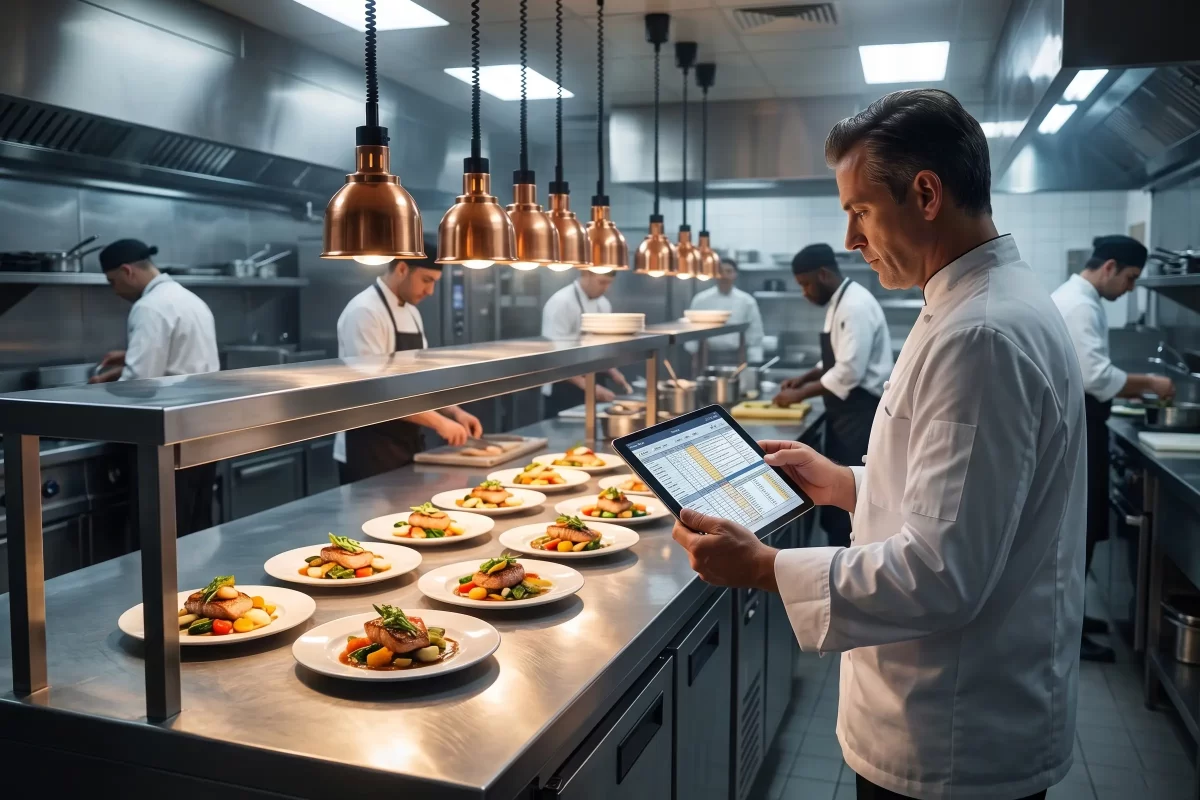
- The Solution: Build a visual matrix above the expo line. Every single dish on the menu must have a high-resolution photograph taken from a top-down angle and a 45-degree angle. Laminate these photos and mount them directly at the plating station. Add specific text overlays indicating portion weights (e.g., “4 oz puree,” “5 sprigs cilantro”). The expeditor’s sole job is to reject any plate that does not look exactly like the photograph.
Framework 4: Integrating Recipe Management Systems (RMS)
Paper recipe binders get lost, stained, and outdated. When recipes change, cooks often rely on an old, memorized version, creating immediate inconsistency across shifts.
- The Hotel F&B Audit Example: A property with a lobby bar, a rooftop lounge, and a banquet hall utilizes the same truffle mac-and-cheese across all three outlets. If the executive chef updates the cheese blend ratio, but only verbally tells the rooftop chef, the property is now serving two different versions of the exact same menu item.
- The Restaurant Audit Example: The food cost on your salmon dish spikes from 28% to 36%. Because your recipes live in a physical binder, you cannot easily track if the prep cooks are yielding the fish incorrectly or if the vendor raised the price per pound.
- The Solution: Deploy cloud-based recipe management systems. Every recipe, prep instruction, and yield expectation must be digitized. When a recipe is updated, it updates globally across all kitchen tablets instantly. This ensures that a cook pulling up the recipe for the signature sauce is always looking at the most current, cost-approved version.
Framework 5: Decoupling Prep from Execution
When the cook who preps the food is the exact same cook who fires the food, they develop blind spots. They will adjust the seasoning on the fly to correct their own prep mistakes, which guarantees that no two batches will ever taste the same.
- The Hotel F&B Audit Example: To maintain absolute hotel F&B consistency, large properties use a commissary kitchen model. A dedicated daytime prep team makes all the mother sauces, butchers the meat, and prepares the bases for all outlets. The nighttime line cooks are simply executing the final heating and plating.
- The Restaurant Audit Example: In a standalone restaurant, the sauté cook spends three hours prepping their own station and then cooks on it for six hours. If they accidentally over-salted the pasta water during prep, every single pasta dish that night will be ruined.
- The Solution: Strictly separate the prep shift from the line shift where possible. The prep team follows the exact digital recipe to produce the base components. The line cooks are the executioners. If a sauce needs “fixing” on the line, it means the prep system failed. By separating these duties, you easily identify where the operational breakdown is occurring and hold the specific team accountable.
Common Pitfalls to Avoid
Operators frequently attempt to systemize their kitchens but fail because they fall into these common, ego-driven traps:
- Surrendering to “Chef Ego”: Allowing a talented but undisciplined chef to constantly alter menu items based on their mood or daily inspiration. While creativity is vital for menu development, it is a liability during service. Once a dish is approved and costed, it is locked. No one, not even the executive chef, is allowed to change the recipe on a whim without updating the master playbook.
- Neglecting the Prep Cooks: Focusing all training and discipline on the hot line cooks while ignoring the morning prep team. The prep cooks are the foundation of your entire menu. If they are cutting vegetables inconsistently or ignoring the digital scales, the hot line will fail regardless of how talented the nighttime cooks are.
- Ignoring Vendor Consistency: Blaming the cooks for inconsistency when the real issue is your purchasing strategy. If you constantly switch purveyors to save pennies, you will receive different sizes, fat contents, and flavor profiles of your core ingredients. You cannot produce a consistent plate of food if your raw materials change every week.
- Skipping the Line Check Under Pressure: The exact day you need the pre-shift line check the most—a fully booked holiday weekend—is the day managers typically skip it because they feel “too busy.” Skipping the line check guarantees that bad prep will make it to the dining room floor.
Apply This Tomorrow (15-Minute Action Plan)
You do not need a massive budget to start institutionalizing your culinary program. You can immediately begin standardizing the kitchen tomorrow by executing these highly specific, low-friction steps:
- Audit Your Measuring Tools: Walk through your prep kitchen tomorrow morning and physically remove all volumetric measuring cups (except for clear liquid quart containers). Hand your prep cooks digital scales and instruct them that all dry ingredients must be weighed from this point forward.
- Print One Master Photograph: You do not need to photograph the entire menu tomorrow. Choose your highest-selling, most frequently returned dish. Plate it perfectly, take a high-resolution photo with your smartphone, print it in color, and tape it to the expo pass before the dinner rush begins.
- Implement the 4:00 PM Taste Test: Set an alarm on your phone for 4:00 PM (or 45 minutes before your service starts). Walk to the hot line with ten tasting spoons. Taste the three most critical sauces or purees. If they are not perfect, make the cooks rebuild them immediately.
- Verify the Yield of One Item: Pick one expensive protein (e.g., a whole tenderloin or a side of salmon). Watch your prep cook butcher it. Weigh the usable product against the waste (trim). Compare that exact yield percentage against what is written in your recipe costing file to see if your margins are actively bleeding out on the prep table.


